Crawl Ratio Explained: Why 4.10s Aren't Enough After a Lift
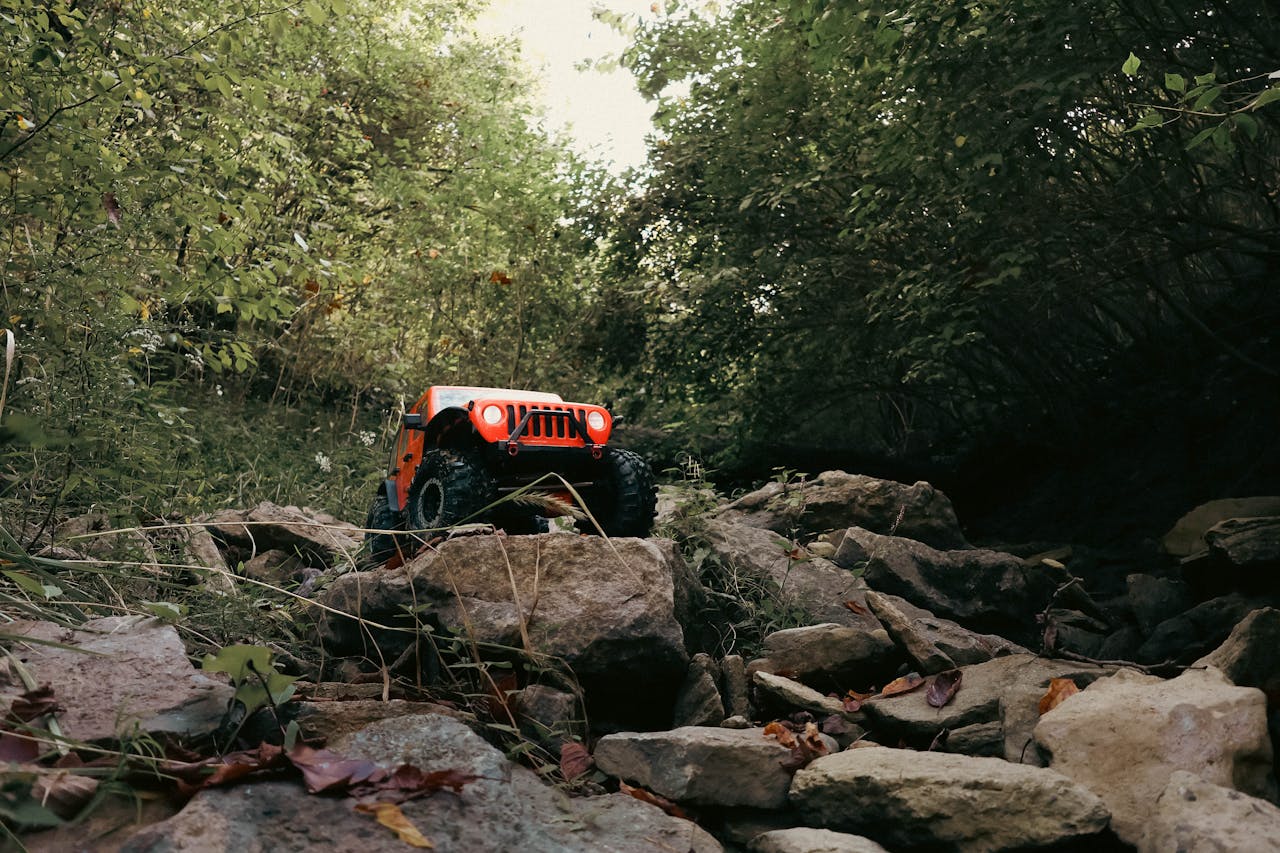
You lifted your Jeep, added 35-inch tires, and hit the trails. Now you’re riding the clutch on every obstacle because first gear is still too fast. You’ve got a crawl ratio problem.
Understanding crawl ratio is the key to understanding why some rigs walk up obstacles while others spin tires or stall.
What Is Crawl Ratio?
Crawl ratio is the total gear reduction between your engine and your wheels in the lowest possible gear. It’s calculated by multiplying:
Crawl Ratio = 1st Gear × Transfer Case Low × Axle RatioHigher crawl ratio = more torque at the wheels = slower minimum speed = better control on obstacles.
Real-World Example
Stock Jeep JK Rubicon:
- 1st gear (manual): 4.46:1
- Transfer case low: 4.0:1
- Axle ratio: 4.10:1
Crawl ratio: 4.46 × 4.0 × 4.10 = 73:1
That’s decent from the factory. But add 35s and everything changes.
Calculate Your Crawl Ratio
Enter your gear specs to see your total crawl ratio and how changes affect it.
Calculate Crawl Ratio →Why Bigger Tires Hurt
Tires act like a final gear. Bigger tires = taller effective gearing = lower effective crawl ratio.
The math:
Effective Crawl Ratio = Actual Crawl Ratio × (Stock Tire Diameter / New Tire Diameter)Going from 32” to 35” tires on that Rubicon:
73 × (32 / 35) = 66.7:1Your effective crawl ratio dropped 9%. That’s why first gear feels too fast and you’re struggling on obstacles you used to walk up.
Crawl Ratio Benchmarks
Different wheeling styles need different ratios:
| Style | Crawl Ratio | Notes |
|---|---|---|
| Mild trails | 40-50:1 | Stock trucks |
| Moderate wheeling | 50-70:1 | Stock Rubicons, lifted rigs |
| Serious crawling | 70-90:1 | Regeared, purpose-built |
| Competition | 100-150+:1 | Twin-sticks, extreme gearing |
Under 50:1 and you’re slipping clutches and using brakes to control speed. Over 100:1 and you can idle up nearly anything.
Options to Improve Crawl Ratio
1. Regear the Axles
Most common solution. Going from 4.10 to 4.88 gears:
Original: 4.46 × 4.0 × 4.10 = 73:1 With 4.88s: 4.46 × 4.0 × 4.88 = 87:1
Pros: Relatively affordable, improves highway RPM too Cons: Affects all gears, not just low range
2. Lower Transfer Case Gears
Aftermarket gears can lower your transfer case ratio:
With 4.0:1 t-case: 73:1 With 4.3:1 t-case: 78:1 With Atlas 5.13:1: 94:1
Pros: Only affects low range Cons: Expensive, especially full case swap
3. Transmission Swap
Some swaps offer lower 1st gear:
Stock AX-15 1st: 3.83:1 NV4500 1st: 5.61:1
That alone improves crawl ratio significantly.
4. Dual Transfer Cases (Twin-Stick)
Running two transfer cases in series multiplies the ratios:
Single t-case: 4.0:1 Twin 4.0:1 cases: 16:1 in double-low
Crawl ratio becomes astronomical. Competition rigs only.
The Trade-Offs
Lower (numerically higher) axle gears:
- ✓ Better crawl ratio
- ✓ Better acceleration
- ✗ Higher highway RPM
- ✗ Worse fuel economy
- ✗ Cost of regear ($1,500-3,000)
Lower transfer case gears:
- ✓ Only affects low range
- ✓ Keeps highway gearing
- ✗ Very expensive (Atlas is $3,000+)
- ✗ Complex install
Bigger tires without regear:
- ✗ Lower effective crawl ratio
- ✗ Gutless on road and trail
- ✗ Engine works harder everywhere
Calculating What You Need
Want to restore your stock crawl ratio after going to 35s?
Needed Axle Ratio = Stock Ratio × (New Tire / Stock Tire)
4.10 × (35 / 32) = 4.48
Closest common ratios: 4.56 or 4.88
4.56 gets you close. 4.88 actually improves on stock—your 35s will crawl better than stock tires did.
Don’t Forget the Trans
Automatic transmissions have lower 1st gear ratios than manuals:
| Transmission | 1st Gear |
|---|---|
| AX-15 (manual) | 3.83:1 |
| NSG370 (manual) | 4.46:1 |
| 42RLE (auto) | 2.84:1 |
| 545RFE (auto) | 3.00:1 |
Automatics start with a disadvantage but can use the torque converter for extra multiplication at low speeds.
The Ground Speed Question
What does crawl ratio actually mean for your speed? At idle (700 RPM) with 35” tires:
| Crawl Ratio | Speed at Idle |
|---|---|
| 50:1 | 3.1 mph |
| 70:1 | 2.2 mph |
| 90:1 | 1.7 mph |
| 120:1 | 1.3 mph |
The difference between 50:1 and 90:1 is the difference between “using brakes constantly” and “can actually crawl.”
Start with the Calculator
Before spending money, calculate what you have and what you need:
- Input your current gears (trans, t-case, axle)
- See your current crawl ratio
- Factor in your tire size
- Experiment with different axle or t-case ratios
- Decide what upgrade makes sense
The math doesn’t lie. If you’re fighting the gearing on the trail, higher ratios will transform the experience.